Executive Card

AI Cost Intelligence

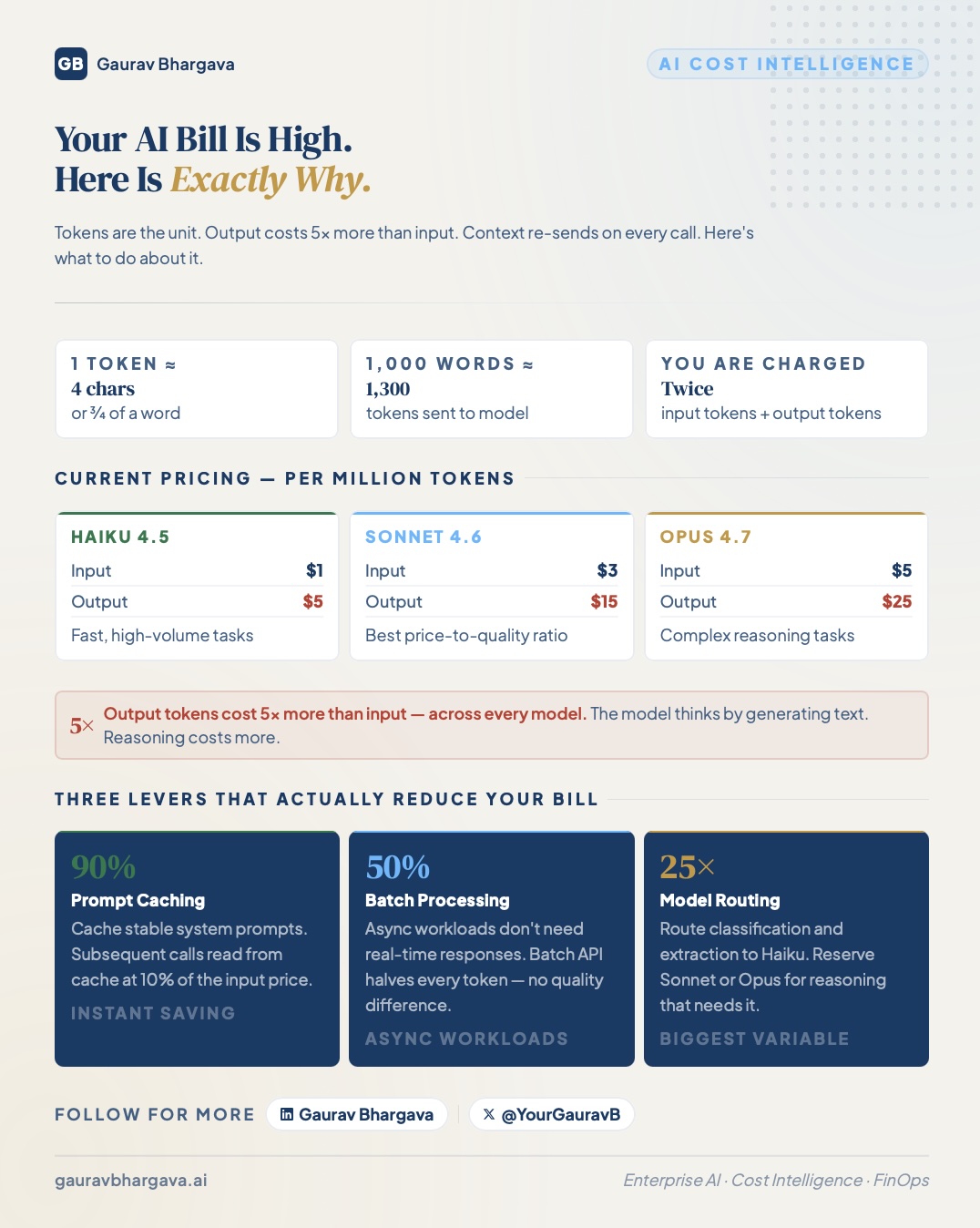
A one-page visual explanation of why AI bills rise, how token economics work, and which levers actually reduce spend.

AI Cost Intelligence executive card explaining token economics and cost levers
Interactive Card

Explore AI cost intelligence.

Use the controls or hover across the card to isolate token basics, pricing dynamics, output-token pressure, and cost-reduction levers.

GB
Gaurav Bhargava
AI Cost Intelligence

Your AI Bill Is High.
Here Is Exactly Why.

Tokens are the unit. Output costs 5× more than input. Context re-sends on every call. Here's what to do about it.

1 token ≈
4 chars
or ¾ of a word
1,000 words ≈
1,300
tokens sent to model
You are charged
Twice
input tokens + output tokens
Current pricing — per million tokens
Haiku 4.5
Input $1
Output $5
Fast, high-volume tasks
Sonnet 4.6
Input $3
Output $15
Best price-to-quality ratio
Opus 4.7
Input $5
Output $25
Complex reasoning tasks
Output tokens cost 5× more than input — across every model. The model thinks by generating text. Reasoning costs more.
Three levers that actually reduce your bill
90%
Prompt Caching
Cache stable system prompts. Subsequent calls read from cache at 10% of the input price.
Instant saving
50%
Batch Processing
Async workloads don't need real-time responses. Batch API halves every token — no quality difference.
Async workloads
25×
Model Routing
Route classification and extraction to Haiku. Reserve Sonnet or Opus for reasoning that needs it.
Biggest variable
Follow for more
Gaurav Bhargava
@YourGauravB
gauravbhargava.ai Enterprise AI · Cost Intelligence · FinOps

Hover each panel or use the controls above to isolate one cost pattern at a time.

Why this matters

AI cost is not one cost. It is an operating model signal.

Many AI cost conversations start with model pricing and stop there. The real cost pattern comes from input tokens, output tokens, repeated context, workload shape, response design, and model routing discipline. This card is designed to make that conversation easier in executive, architecture, and AI FinOps discussions.

How to use it

Use this in cost and platform reviews.

  • Explain why output-heavy use cases cost more.
  • Separate real-time work from batchable work.
  • Start a model-routing discussion with business and platform teams.
  • Use caching as a practical lever for stable prompts and repeated context.
Key takeaways

The levers are operational.

  • Token volume matters, but repeated context matters more than many teams expect.
  • Output tokens can become the hidden cost driver.
  • Prompt caching, batching, and routing are design decisions, not only engineering tricks.
  • AI cost governance should sit close to workload design.